


Once Upon a Time on the Web: What Was the First .com Domain in History? (Spoiler: It Wasn't Google)
On March 15, 1985, the first .com domain was registered, predating the birth of the World Wide Web by years. We explore the story of Symbolics.com and how that event established the digital infrastructure we still use today.

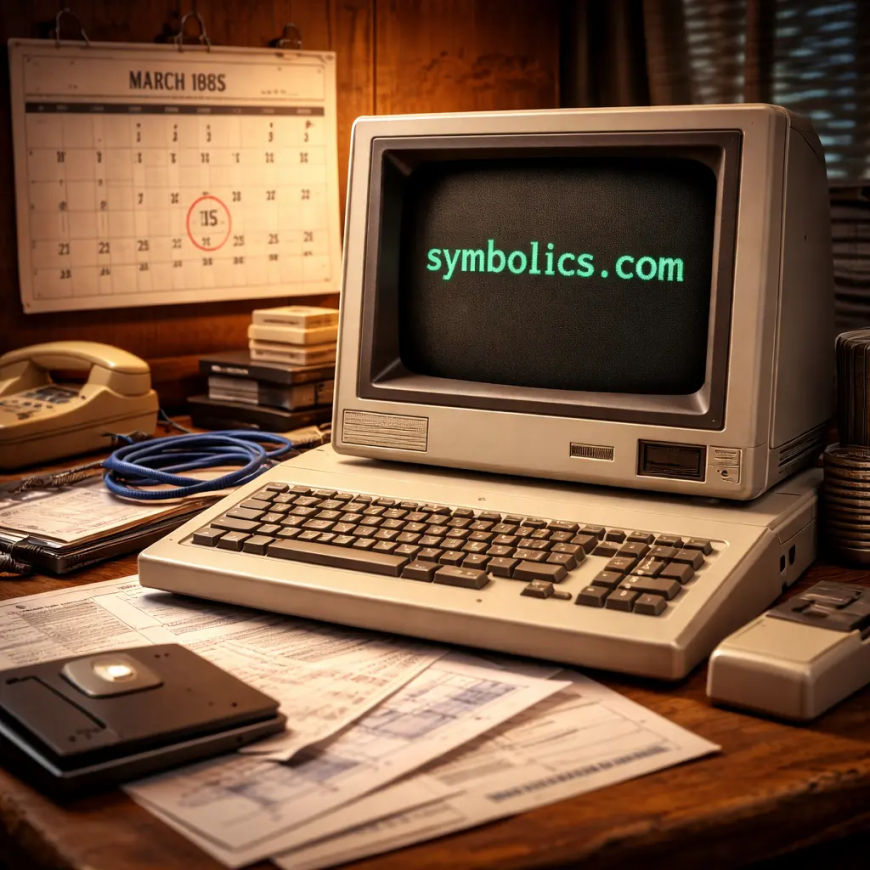
Often, when we work on digitization projects or configure complex cloud infrastructures, we tend to take for granted the architecture that supports our entire ecosystem. We imagine the network as a fluid, modern entity, dominated by the giants that control global traffic today. If we were to ask an average user what the first commercial foothold on the network was, the answer would almost certainly fall on familiar names like Google, Amazon, or perhaps Microsoft. Yet, historical and technical reality tells a very different story, rooted in an era when the World Wide Web as we know it today was not even an idea on paper.
The story of the first .com domain registered in the world takes us back to March 15, 1985. There were no graphical browsers, no social networks, and monitors glowed with green or amber phosphors against a black background. On that date, a company called Symbolics Computer Corporation officially registered symbolics.com. This event marked, without anyone being able to foresee its magnitude, the beginning of the commercial colonization of cyberspace.
At GoBooksy, we often find ourselves explaining to our partners that the Internet and the Web are not synonymous. When Symbolics registered its domain, Tim Berners-Lee had not yet written the proposal for the World Wide Web, which would only arrive four years later, in 1989. The network of 1985 was an archipelago of university computers, government research centers, and military contractors connected via protocols that were laboriously evolving toward the TCP/IP standard. Registering a domain was not for creating a showcase site or an e-commerce store, but to uniquely identify a machine or a network of machines within a system that was becoming too vast to be managed manually.
Symbolics was not a startup born in a California garage according to the romantic narrative of Silicon Valley in the nineties. It was a spin-off company from the MIT Artificial Intelligence Laboratory, specializing in the production of Lisp machines, extremely powerful workstations designed for advanced software development and artificial intelligence. They were hardware and software pioneers seeking an efficient way to be reachable on the nascent network, then dominated by .edu (universities) and .mil (military) extensions. The creation of the .com TLD (Top-Level Domain) was intended precisely to accommodate "commercial" entities, a category that at the time seemed almost like an intruder in a purely academic and strategic environment.
Analyzing historical logs and the DNS structure, we notice how incredibly slow the initial progression was. Today, we register and manage hundreds of domains in a few hours for our clients, but in 1985, after symbolics.com, months passed before anyone else stepped forward. The second domain, bbn.com, arrived in April, followed by https://www.google.com/search?q=think.com in May. To see names we recognize today as tech colossi, one must scroll through the calendar much further: IBM registered its domain only in March 1986, Intel and HP in the same year, while Apple arrived in 1987 and Microsoft as late as 1991. Google, to be clear, would not appear on the DNS map until 1997.
This initial slowness makes us reflect on a concrete problem we still face today: the adoption of new technologies is never immediate, even when the infrastructure is ready. The Domain Name System (DNS) was introduced to solve a scalability problem. Before DNS, the mapping between numerical addresses (IP) and readable names was managed via a single text file called HOSTS.TXT, maintained centrally and distributed manually to all computers on the network. It was an unsustainable method for a growing network. DNS automated and decentralized this process. When we configure DNS records for a GoBooksy ecosystem today, we are using the same logical foundations laid in that distant 1985. The robustness of that technical choice is demonstrated by the fact that, forty years later, it remains the pillar upon which the entire digital economy rests.
The story of Symbolics.com is also a warning about the volatility of technological success. While the domain has remained active uninterruptedly, becoming the oldest existing piece of digital real estate, the company that registered it had a troubled fate. Lisp machines, despite being technologically superior, were crushed by the advent of low-cost commercial processors and the spread of general-purpose software. The company went bankrupt, but the domain survived, passing from hand to hand until it became a digital museum piece.
Observing this fragment of history helps us better understand the value of digital ownership. We often see companies worrying excessively about the aesthetics of their website, neglecting the management and security of the domain itself, which is the true primary asset. A domain is not just an address; it is persistent identity in a sea of constantly changing data. Symbolics.com teaches us that technologies change, companies rise and fall, graphical interfaces evolve, but the name with which we present ourselves to the network has a longevity that can exceed that of the business itself.
Today, visiting that first .com domain is almost an archaeological experience. We no longer find specifications for artificial intelligence workstations there, but the testimony of a primacy. For us at GoBooksy, retracing this genesis is not just an exercise in nostalgia, but a way to remember that behind every click, every email, and every cloud transaction, there exists a precise logical structure, born from the need to bring order to information chaos. Understanding where we come from allows us to design the digital architectures of tomorrow with greater awareness, respecting protocols that have proven they can withstand the toughest test of all: time.