

The First Bug in History Was Real: When Computing Clashed with Nature
On September 9, 1947, in a Harvard lab, the term "bug" took on a literal meaning. We analyze the Mark II incident and how a simple moth defined the concept of computer error forever, turning hardware maintenance into a legend that still influences our approach to debugging today.

In our daily work, when we talk about a "bug," we are almost always referring to a logic error, imperfect syntax, or an undeclared variable blocking an entire application. We live immersed in an ecosystem where errors are abstract—a sequence of zeros and ones failing to align as they should. Yet, whenever our teams tackle a complex debugging session on remote servers or cloud architectures, we like to remember that there was a precise moment in history when computing was not made of silicon and light, but of metal, electricity, and deafening noise. In that context, looking for an error meant getting your hands dirty and, in one specific and legendary case, physically removing an insect from the calculation mechanisms.
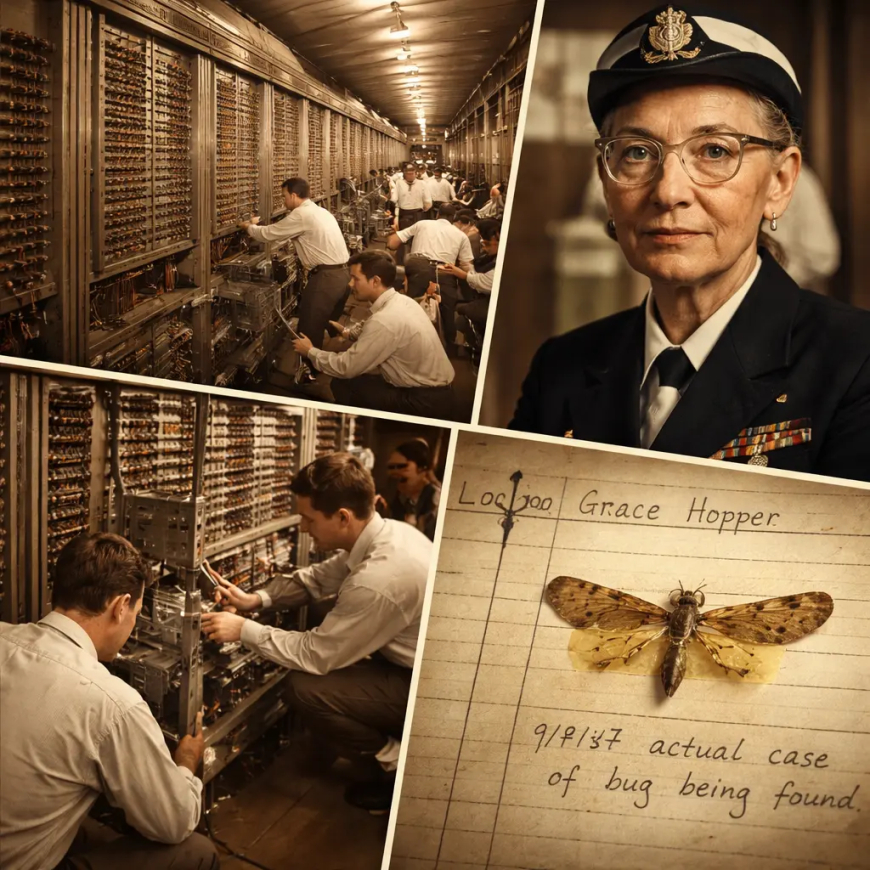
The date that marked this semantic transition is September 9, 1947. We find ourselves at Harvard University, where a team of engineers and mathematicians is operating the Mark II Aiken Relay Calculator. We are not talking about the silent computers that populate our desks today, but an imposing electromechanical machine, a colossus of relays occupying entire rooms, whose operation produced a rhythmic and constant ticking, similar to thousands of typewriters in simultaneous action. For those of us who manage infrastructures where silence is broken only by cooling fans, imagining the operational clamor of the Mark II is almost impossible, but it is fundamental to understanding the physicality of that technology.
That late summer afternoon, the machine suddenly stopped functioning correctly. Operators noticed a malfunction in Panel F. Unlike modern debugging, which often begins with analyzing log files on a screen, the procedure required a visual and manual inspection of internal components. It was while digging through cables and switches that the team located the cause of the blockage in Relay number 70. Trapped between the electrical contacts, crushed by the mechanical movement it had itself prevented, was a moth. The insect had created an unforeseen insulation, interrupting the circuit and causing the calculation operation to fail.
The team's handling of that event, led by the extraordinary figure of Grace Hopper, transformed a simple technical breakdown into an iconic moment. The moth was removed delicately, but not thrown away. It was taped into the computer's activity logbook, right next to the time 15:45. The handwritten note below the insect read: "First actual case of bug being found." This phrase is revealing and often misunderstood. The term "bug" was already used in engineering circles since the days of Thomas Edison to indicate small defects or inexplicable interference in mechanical and electrical systems. The genius of that moment lies in making a metaphor literal: the "bug" disturbing the system was, for the first time, a real insect.
Looking today at that logbook page, preserved at the Smithsonian National Museum of American History, we notice how much our relationship with error has changed, while remaining conceptually identical. The 1947 moth reminds us that the digital always rests on a physical base. Even in our most advanced virtualization projects, there is a level where hardware must obey the laws of physics. Overheating, a defective network cable, or in extreme cases, environmental interference, represent the modern version of that moth. Debugging, a term Grace Hopper helped standardize precisely after that event, was born as a physical cleaning operation and evolved into a logical process, but the required discipline remains the same: isolate the problem, analyze the cause, and restore the correct flow of information.
Often, when we analyze critical malfunctions in our clients' systems, we realize the tendency is to immediately seek complex solutions, ignoring the most elementary causes. The lesson of the Mark II is a call to pragmatism. Sometimes the problem is not in the algorithm, but in the infrastructure hosting it. That moth stopped flying almost eighty years ago, but it continues to remind us that technology, however ethereal and advanced it may seem, must always reckon with the material reality surrounding it. The first bug was real, tangible, and fragile; an accidental collision between the biological world and the dawn of the computational era that defined the language with which we still describe our digital obstacles today.