
Why does Bluetooth use a Viking rune symbol? The real story you don’t expect
Discover the true story behind the Bluetooth logo, a blend of wireless technology and Scandinavian history uniting Intel, Ericsson, and a 10th-century Viking king. An operational journey into interoperability.

Every day, when we activate the connection between our devices to transfer data or link peripherals, we see a small, stylized blue icon light up. In our offices at GoBooksy, where we manage communication flows across countless devices, that symbol has become so ubiquitous that it is virtually invisible, a taken-for-granted piece of digital furniture. Yet, behind those geometric shapes inhabiting the status bar of our smartphones and the dashboards of our cars, hides a story of technological convergence that traces its roots back to the 10th century, intertwining modern engineering and Scandinavian mythology in a way that rarely happens in the IT sector.
To understand the true nature of that symbol, we must look beyond mere aesthetics and return to the late 1990s. At that time, the landscape of short-range communication was fragmented and chaotic. Major tech companies were working on proprietary standards incompatible with one another to eliminate cables: Intel had its Business-RF, Ericsson was working on MC-Link, and Nokia on Low Power RF. We, who operate daily with system integration, know how paralyzing the lack of a common standard can be. The concrete risk was creating a digital ecosystem where devices could not talk to each other unless they belonged to the same brand, an operational nightmare that would have slowed mobile evolution for decades.
The turning point occurred in 1997, not in a sterile laboratory, but during an informal conversation between Intel's Jim Kardach and Ericsson's Sven Mattisson. While discussing history as they sought common ground to unite their technologies, the deeds of King Harald Gormsson, a ruler of Denmark and Norway who lived a thousand years prior, emerged. This king was famous for his diplomatic and military ability to unite Scandinavian tribes perpetually at war with each other, bringing cohesion to a divided land. Legend has it that he was nicknamed "Blåtand" (Bluetooth in English), perhaps due to a dark, necrotized tooth that stood out in his smile.
The analogy immediately struck the project's founders. The goal of the new technology was exactly what King Harald had done with the Viking tribes: to unite different communication protocols, such as those of computers and mobile phones, under a single universal standard. At GoBooksy, we often observe how the right metaphors can accelerate the adoption of complex technologies, and in this case, the codename "Bluetooth" was chosen as a temporary placeholder while marketing worked on the official names, which were supposed to be RadioWire or PAN (Personal Area Network).
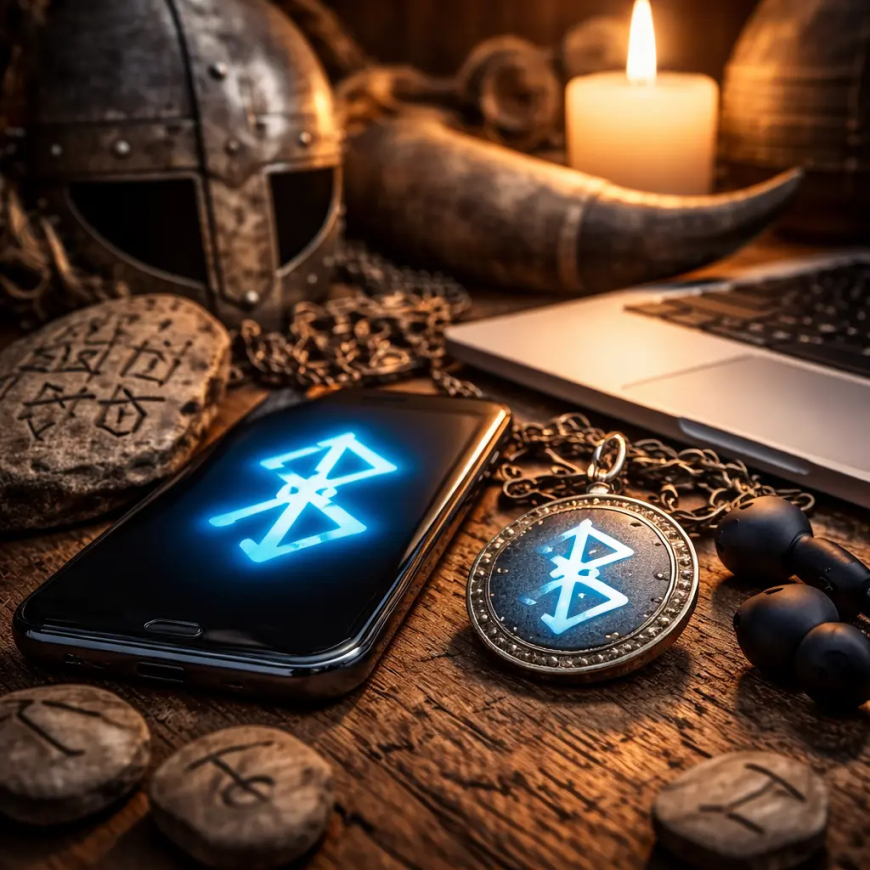
The symbol we know today is not a simple abstract design but a perfect example of a "bindrune," a ligature typical of runic inscriptions. The logo stems from the superimposition of two characters from the Younger Futhark runic alphabet: the rune Hagalaz (ᚼ), corresponding to our H, and the rune Berkana (ᛒ), corresponding to B. Merged together, Harald Bluetooth's initials form the geometric glyph that features on billions of devices. It is fascinating to note how a futuristic technology chose to represent itself through a writing system that predates the printing press by centuries, creating a semantic bridge between ancient communication carved in stone and modern data transmission via radio waves.
The permanence of this name and its logo is, ironically, the result of a procedural accident typical of the corporate world. When the time came for the official launch, the names proposed by the marketing departments could not be used: PAN was considered too generic from a legal standpoint and would have created confusion in search engines, while the trademark search for RadioWire was not completed in time for the presentation. The codename, intended to be provisional, thus became the de facto standard. This dynamic often reminds us, in our projects at GoBooksy, that solutions born of practical necessity tend to take root much more deeply than those constructed on paper.
Today, the runic Bluetooth symbol is much more than a historical homage. It represents the victory of interoperability over fragmentation. Every time a headset connects instantly to a phone of a different brand, we are witnessing the technical realization of that unification its creators dreamed of in Toronto bars in the late nineties. The blue color, which initially recalled the king's nickname, has become synonymous universally with "device ready for connection," creating a visual language that transcends linguistic barriers.
The history of Bluetooth teaches us that innovation does not only look forward but sometimes needs to look back to find its own identity. In an often ephemeral digital world, where technologies are born and die within a few years, carrying a millennial Viking rune in our pockets is a powerful reminder of how communication, in all its forms, has always been the fundamental tool for uniting diverse worlds.